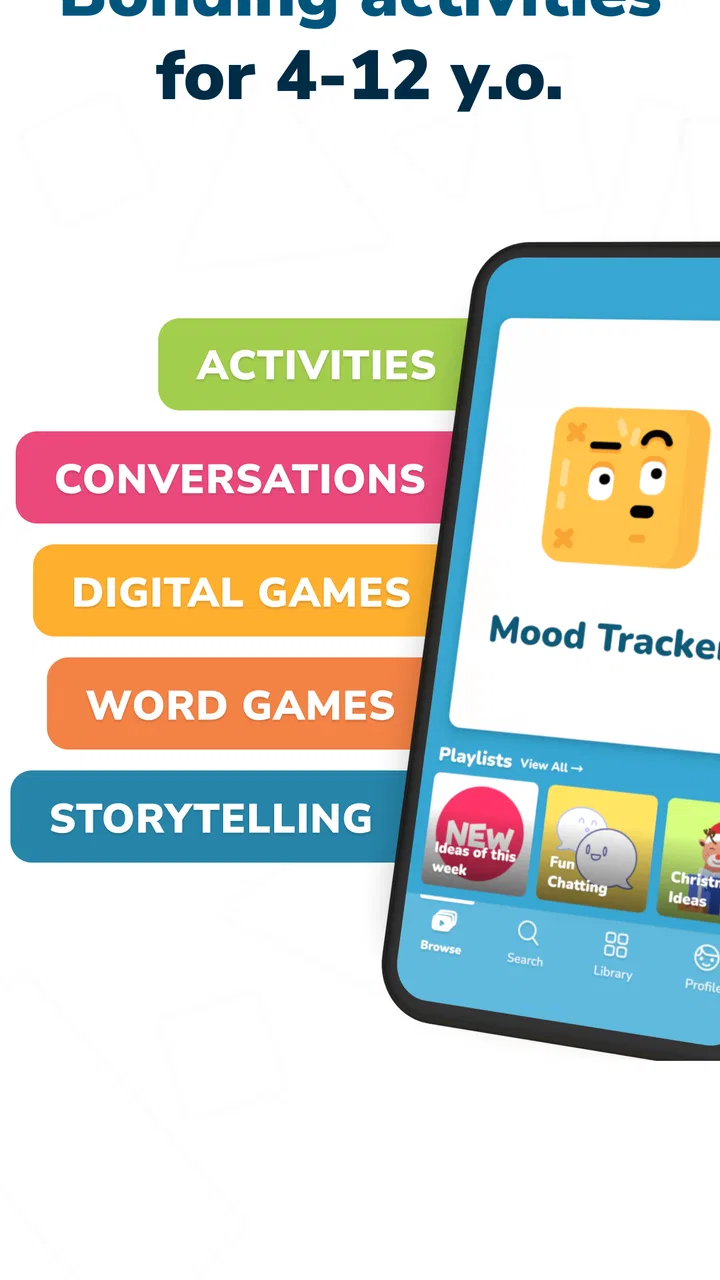
Hearty App: Everyday Bonding
- 4.6
- Rating
- 500.00K
- Installs
- Free
- Price

 Analysis by App-foxy
I approached Hearty App: Everyday Bonding as a practical parenting companion rather than another app that expects me to spend long stretches staring at my phone. Its central promise is simple: give parents approachable ideas for spending better time with children. In everyday life, that matters because the hardest part is often not caring, but thinking of something suitable when everyone is tired, busy, or stuck indoors.
After using it, I see its value in the small moments between routines. It is an app for parents who want prompts, activities, and inspiration they can actually turn into family time, not a replacement for conversation or attention. The app is free to install, while in-app purchases range from $4.99 to $49.99 per item, so it is easy to try before deciding whether the paid options fit your family.
Pathfinder DMCC is the developer behind this parenting app. It has reached over 500K installs and holds a 4.5 average from around 1.9K ratings, which suggests that its straightforward approach has connected with a sizeable group of families. The Everyone age rating also makes the app feel approachable as a household tool, although parents should still use their own judgement about whether a particular suggestion suits their child.
You May Also Like

 Blood Strike: 2.5 Anniversary
Blood Strike’s Loadouts Turn Every Drop Into a Tactical Gamble
A close look at Blood Strike’s custom loadouts: how fast access to signature weapons reshapes its battle royale rhythm, rewards preparation, and narrows the gap between fights.

 Pandora - Music & Podcasts
Pandora’s Music Is Easy to Start, but Harder to Recover
Pandora’s strength is its low-effort path from a seed to a station. Its weak spot is how much confidence it asks you to place in connection, setup, and quiet recovery.

 8 Ball Pool
 Is Built on Rivalries, Rematches, and Routine
A close look at the rivalries, rematches, shared routines, and unanswered safety questions that turn a quick pool match into a persistent mobile community.

 Samsung Music
’s Quiet Strength Is Playing What You Already Own
Its reach comes less from spectacle than from dependable access to a personal library. That simplicity is both the app’s strongest retention engine and its ceiling.

 AccuWeather: Weather Radar
AccuWeather Review: A Quick, Clear Forecast for Everyday Decisions
For everyday plans, the best forecast is the one you can understand quickly. AccuWeather makes rain timing, radar, and local conditions easy to act on, with a few trade-offs.

 Hill Climb Racing
Why Hill Climb Racing Still Turns Crashes Into One More Run
A tiny car, a bumpy hill and one more upgrade: Hill Climb Racing keeps resurfacing because its simple chaos makes every near-miss feel personal.
More From Our News Desk



How I built a useful everyday routine with the app
I found the routine worked best when I treated the app as a planning aid, not a task list: I chose one idea ahead of a likely family moment and left room to change course. In this section, I’ll focus on how to make that habit sustainable, including a simple way to notice which kinds of activities fit your household without turning family time into tracking or homework.
Starting with a small, realistic habit
The most effective way to use Hearty App is not to open it only when the family is already bored. I found it more useful to make it part of a predictable routine. A quick look earlier in the day lets me choose one idea that matches the time, energy, and space available. That small decision removes the pressure of inventing an activity at the exact moment a child asks, “What can we do?”
This is particularly helpful on ordinary weekdays. A parent may have only a short window before dinner, homework, bath time, or bedtime. In that situation, an activity that is easy to begin is more valuable than an ambitious project that requires preparation. I recommend choosing ideas based on the family’s actual conditions rather than selecting the most exciting-looking option.
For example, if my child has had a tiring day, I would favour something calm and conversational instead of an activity that needs lots of movement. If the weather prevents outdoor plans, the app can serve as a starting point for an indoor alternative. The important shift is to treat its suggestions as building blocks. I do not need to follow an idea rigidly; I can shorten it, simplify it, or adapt it to the child’s age and mood.
A practical after-school scenario
Imagine an after-school period when a child is restless, a parent is preparing food, and neither person wants to begin a complicated craft. I would open the app before the rush, scan for an idea that can happen nearby, and set it up with whatever is already available. The activity then becomes a short connection point rather than a major event.
That distinction is one of the app’s strongest qualities. Family bonding does not always need a full afternoon or a carefully planned outing. A few focused minutes can work when the activity gives both people something to do and something to talk about. I found that the best results came from staying present instead of treating the app as a babysitter.
Parents should also resist the temptation to turn every suggestion into a test. If a child loses interest quickly, that is useful information, not a failure. The app works better when I use it to open a door and then follow the child’s response. Sometimes the original activity becomes a conversation, a joke, or a different game entirely.
Saving mental energy through repeatable choices
A less obvious benefit is that repeated use can reduce decision fatigue. Parents make countless small choices every day, and selecting a family activity can become another task. I found it helpful to keep a mental shortlist of ideas that suit our home, available time, and children’s personalities. The app supplies the spark; experience tells me which sparks are worth returning to.
This approach also prevents overuse. I would not scroll through every suggestion looking for a perfect answer. That can turn a simple bonding moment into another screen-based chore. Instead, I would give myself a short browsing window, choose one reasonable option, and move on. The goal is less searching and more shared attention.
Who will get the most from it?
Hearty App is best suited to parents who want fresh prompts for everyday connection. It can be useful for families with young children, parents adjusting to a new routine, and adults who feel they are repeating the same few activities. It may also help relatives or caregivers who want ideas for meaningful time together without relying entirely on television, games, or expensive outings.
It is less suitable for someone looking for a detailed child-development program, a formal educational curriculum, or a complete family scheduling system. I would also skip it if I wanted an app that automatically manages household tasks or tracks a child’s progress in depth. Its strength is inspiration and practical bonding, not comprehensive parenting administration.
What I would check before relying on it
The current version is 3.25.4, and it supports devices running Android 7.0 or later. That makes compatibility reasonably broad for Android users, but I would still check the device requirements before planning to use it on an older phone or tablet. Families sharing one device should also decide in advance where and when it will be used, since the app is most valuable when it leads quickly to offline interaction.
The free entry point is useful for testing the style of the suggestions. I would spend time with the free experience before buying anything, especially if I already have a large collection of family activity ideas. The paid range is wide enough that the decision should be based on whether the additional material genuinely saves time or adds variety for your household, rather than on the assumption that more content automatically means better bonding.
Settings and choices worth checking first
Experienced use begins with a short setup check rather than immediately browsing. I would look at any available preference controls and make sure the app’s notifications, if enabled, match my routine. Parenting apps can become irritating when reminders arrive during school runs, work meetings, or bedtime. A useful reminder should support a habit, not create another interruption.
I would also check how the app presents suggestions and whether the browsing experience feels comfortable on the device being used. If a child is likely to see the screen, I would preview ideas myself first. The Everyone rating is reassuring for general access, but an age label does not replace a parent’s judgement about tone, materials, mess, supervision, or emotional suitability.
Another sensible step is to establish a family rule about the phone. I prefer using the app as a menu, then putting the device aside. If it remains in hand throughout the activity, the tool can undermine the very connection it is meant to encourage. This is not a flaw unique to Hearty App; it is a trade-off of using digital inspiration for offline family time.
Turning settings into a calmer routine
Rather than changing options constantly, I would make one deliberate adjustment and observe whether it improves the experience. For instance, if reminders feel distracting, reducing them is better than abandoning the app. If the family prefers spontaneous use, leaving notifications off may be the right choice. If a parent tends to forget the app exists, a carefully timed reminder can make it easier to maintain a weekly habit.
I would also keep expectations modest. No setting can know whether a child is hungry, overstimulated, shy, or eager for attention. The parent remains the filter. A suggestion that looks perfect in the morning may be wrong after a difficult afternoon, so flexibility matters more than finding a permanent configuration.
Faster patterns for busy parents
The fastest workflow I found was based on three questions: how much time do we have, how much energy is available, and what kind of connection does my child need today? Answering those questions first narrows the choice before I even browse. It prevents me from selecting an activity simply because it sounds impressive.
For a short window, I would choose something with a clear beginning and end. For a child who wants attention, I would favour an idea that encourages talking or cooperation. For a high-energy moment, I would look for something active, provided the space and supervision make sense. This simple filter makes the app feel more personal without pretending it can replace knowledge of the child.
A second useful pattern is to prepare a “fallback” idea. If the first activity needs materials I cannot find, or my child rejects it, I do not want to return to endless scrolling. I keep one simpler alternative in mind. The app is more effective when it helps me make a decision quickly, not when I expect it to solve every situation perfectly.
Using the app with more than one child
Families with siblings may need to adapt suggestions so that one child does not dominate. I would read the idea first and decide whether it supports turns, teamwork, or parallel participation. If an activity naturally favours one age group, I would give the older or younger child a different role rather than forcing identical participation.
This is an important trade-off. A general parenting app can offer a useful starting point, but it may not understand the exact gap between siblings, their interests, or their current relationship. The parent has to add that context. When I do, a simple idea can become a cooperative challenge rather than another source of arguments.
What the app cannot replace
Hearty App does not remove the need for planning, supervision, or emotional awareness. A suggestion may be convenient, but it still requires an adult to decide whether the timing is right and whether the child wants to participate. Parents looking for medical, therapeutic, developmental, or behavioural guidance should use an appropriate specialist resource instead of treating activity ideas as professional advice.
It also cannot guarantee that every suggestion will work. Children’s interests change quickly, and an activity that succeeds one day may fail the next. I consider that normal. The app’s role is to increase the number of possibilities available to me, not to provide a magic formula for perfect family time.
Where alternatives may be better
The usual alternative is to rely on memory, social media, books, or a general web search. Those options can provide more depth, but they also create more work. Searching the web often means sorting through long pages, advertisements, and ideas that are unrealistic for the time available. A book can be more focused and calmer to use, yet it may not offer the same sense of variety.
Hearty App sits between those choices. It is more directed than a broad search and less specialised than a parenting book built around one age or method. That makes it convenient for parents who want a quick prompt, but it may feel too general for someone who wants carefully structured progression. I would choose a book or expert-led resource when I needed depth; I would choose this app when I needed a practical nudge right now.
The free model also affects the comparison. Trying it costs nothing, but the in-app purchase range means families should decide whether the extra material offers enough value for their own routine. Someone who already has plenty of activities and enjoys planning may not need to pay. Someone who repeatedly runs out of ideas may find the convenience worthwhile.
Advanced use without overcomplicating family time
My preferred advanced method is to use the app as a weekly planning prompt, not a daily obligation. I would browse once, identify a few possibilities, and match them to likely moments in the week. One could suit a quiet evening, another a rainy afternoon, and another a weekend when there is more energy. This creates variety without requiring constant phone use.
I would also note which ideas lead to natural conversation. Those are often more valuable than activities that look elaborate but end quickly. Over time, I can build a personal sense of what encourages my child to talk, cooperate, laugh, or settle. That is a stronger form of personalisation than simply expecting the app to know us automatically.
A further insight is to use unsuccessful suggestions as feedback. If an activity repeatedly fails, I would examine the cause: too many steps, the wrong time of day, too much competition between siblings, or a mismatch with the child’s interests. The next choice can then be simpler or more collaborative. In that way, the app becomes part of a learning loop for the parent, even though it is not a formal tracking system.
Limits that experienced users should accept
The app’s convenience comes with a degree of generality. Parents who want detailed filters for age, materials, duration, learning goals, or household constraints may find the experience less precise than a specialised resource. I would not install it expecting a fully engineered activity database that plans every detail for me.
There is also a risk of turning bonding into a checklist. If I focus too much on completing suggestions, I can miss what my child is actually communicating. The best use is deliberately loose: choose an idea, begin together, and abandon or reshape it when the moment calls for something else.
Finally, the app cannot create time where none exists. It can reduce the effort of choosing an activity, but parents still need enough attention to participate. For families facing serious stress, conflict, or exhaustion, a simple shared conversation may be more appropriate than any planned activity. That is a limitation worth acknowledging because usefulness depends heavily on context.
My verdict after making it part of family life
I recommend Hearty App: Everyday Bonding to parents who want a friendly source of ideas and need help turning spare moments into intentional time together. Its best quality is not that it promises spectacular experiences; it makes ordinary connection easier to begin. The free starting point lowers the risk of trying it, and the strong rating from its user base reflects that many people find the concept worthwhile.
I would approach the paid options carefully and judge them by how often they genuinely help my household. I would also keep the phone out of the centre of the activity, preview suggestions when necessary, and adapt every idea to the child rather than following it mechanically. Those habits make a bigger difference than simply installing the app.
For parents who want a structured curriculum, specialist guidance, or detailed family management tools, another category of app will be a better match. For parents who regularly think, “I want to do something together, but I have no idea what,” this app is a sensible companion. Its real strength is turning decision fatigue into a small, usable invitation to connect.
Overall, I see it as a practical parenting aid rather than an essential system. It works best when used lightly, with realistic expectations and an adult willing to bring the warmth, humour, and flexibility that no app can supply. That balance is why I would keep it available for busy days, while still relying on conversation, imagination, and familiar family routines as the foundation.
FAQs for Hearty App: Everyday Bonding
01What is Hearty App: Everyday Bonding, and how does it work?
Hearty App: Everyday Bonding is a social application designed to help users strengthen relationships with friends and family through engaging activities and prompts. It offers daily challenges, conversation starters, and shared experiences that encourage meaningful interactions and emotional connections. The app's intuitive interface makes it easy to navigate and use on a daily basis.
02Is Hearty App: Everyday Bonding available for both Android and iOS devices?
Yes, Hearty App: Everyday Bonding is available for download on both Android and iOS platforms. You can find it on the Google Play Store for Android devices and the Apple App Store for iOS devices. Make sure your device meets the minimum system requirements for a smooth user experience.
03Does Hearty App: Everyday Bonding require a subscription or offer in-app purchases?
Hearty App: Everyday Bonding offers a free version with basic features. However, to access premium features such as exclusive challenges and customization options, users can opt for a subscription. The app provides various subscription plans, and users can choose one based on their needs and budget.
04Is Hearty App: Everyday Bonding safe for children to use?
Hearty App: Everyday Bonding is designed for users of all ages, but parental guidance is recommended for younger users. The app includes content that encourages positive interactions, but parents should review the app's settings and features to ensure a safe and age-appropriate experience for their children.
05How does Hearty App: Everyday Bonding ensure user privacy and data security?
Hearty App: Everyday Bonding prioritizes user privacy and data security by implementing robust encryption protocols and privacy settings. Users can control the information they share and with whom they share it. The app's privacy policy provides detailed information about data collection and usage, ensuring transparency and user trust.
Pros
- User-friendly interface for seamless navigation.
- Wide range of bonding activities available.
- Customizable reminders for daily check-ins.
- Secure
- private platform for sharing moments.
- Integrates with social media for easy sharing.
Cons
- Limited free version features.
- Occasional sync issues with some devices.
- Requires stable internet connection.
- No offline mode for activities.
- In-app purchases can add up quickly.

Hearty App: Everyday Bonding
Gallery